Cigarette butts are the most littered plastic item in the world, with trillions discarded improperly each year. Flicked from moving vehicles or dropped on the ground and crushed underfoot, they are often treated as harmless litter. In reality, cigarette filters are made from cellulose acetate, a synthetic plastic fiber that does not naturally biodegrade. Since 2012, cigarette butts have been recyclable through TerraCycle's mail-in cigarette recycling program.
Public health and environmental organizations launched aggressive anti-smoking campaigns throughout the 1980s and 1990s. Advertising restrictions, indoor smoking bans, and public education campaigns helped reduce the percentage of U.S. adults who smoked from a peak of 42% in 1965 to 29.5% in 1990. Higher state and federal tobacco taxes implemented during the 2000s contributed to an even steeper decline, bringing the adult smoking rate to approximately 14%.
In 2003, Chinese pharmacist Hon Lik invented the electronic cigarette as a smoking cessation aid. Introduced to the U.S. market in 2007, e-cigarettes were promoted as an alternative to traditional cigarettes. Millions of smokers switched to vaping, despite the fact that most major health organizations and smoking cessation programs did not endorse e-cigarettes as a proven method for quitting. Recognizing an opportunity to offset declining cigarette sales, tobacco companies quickly entered the vaping market by acquiring, manufacturing, and promoting e-cigarette products.
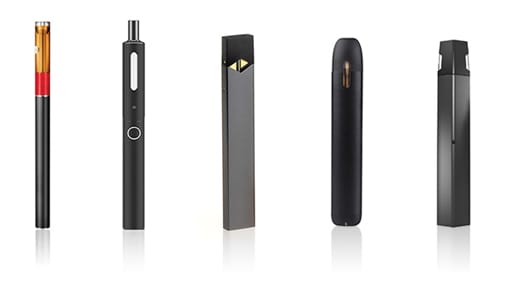
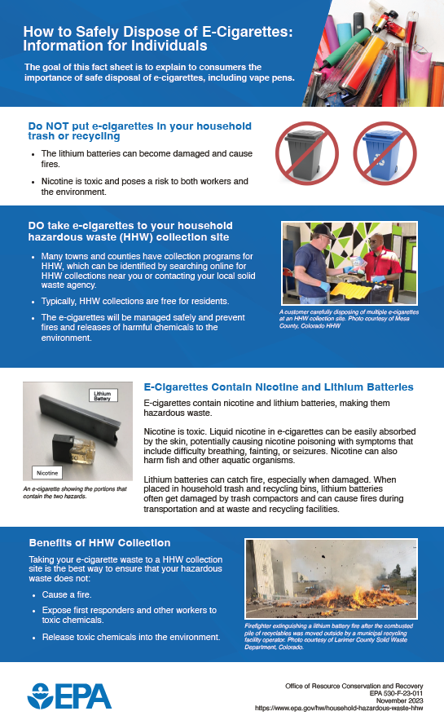
As vaping became more popular, manufacturers introduced an ever-expanding variety of products, including so-called "disposable" vapes. The term is misleading. E-cigarettes and vaping devices are hazardous waste and should never be discarded in curbside trash or recycling bins. Unfortunately, many are thrown away with the same disregard as cigarette butts, frequently ending up along roadsides and in public spaces.
The rapid growth of vaping has created a significant environmental challenge because disposable vapes combine plastic waste, electronic waste, and hazardous chemical waste into a single non-biodegradable product. Their lithium-ion batteries can ignite dangerous fires in collection trucks, transfer stations, and recycling facilities. The plastic casings persist in the environment, while residual nicotine, heavy metals, and heating elements can leach harmful substances into soil and water. As a result, discarded vape devices have become one of the most difficult waste streams municipalities must manage.
The South Shore Recycling Cooperative, of which Pembroke is a member, advises residents to bring e-cigarettes and vaping devices to household hazardous waste collection events or designated collection sites. The cooperative is also working closely with the Massachusetts Department of Environmental Protection to develop long-term solutions for managing these products. TerraCycle has also expanded its recycling programs to include vape devices, building on its success in recycling other difficult-to-manage waste streams.
For more information about TerraCycle recycling programs, visit www.terracycle.com.
For guidance on the safe disposal of e-cigarettes and vaping devices, visit the U.S. Environmental Protection Agency's webpage on e-cigarette disposal: www.epa.gov/hw/how-safely-dispose-e-cigarettes-information-individuals