Pembroke’s curbside recycling audit began on June 22 and will continue through July 3. Once a year the town's recycling undergoes this process to determine the contamination rate. Each day for two weeks a sample is taken from the daily load, contaminants are separated, and the percentage is calculated by weight. After the two-week audit, the daily statistics are calculated to determine the average total rate. That rate is given a dollar value that the town will carry for the next year. Pembroke's goal is set at 10% because every ton over 10% increases the cost of sorting.
As a member of the Town’s Recycling and Sustainability Committee, I was invited to observe the first day of the audit. Having attended the 2025 audit, I was already familiar with both the facility and the process.
I arrived at the Waste Management facility in Avon at 10:00 a.m. on Monday morning, wearing my steel-toed boots. Inside the front lobby is a small waiting area, its walls lined with plaques explaining why each employee considers “Safety First” the most important principle in the workplace. It is a fitting reminder, as the facility is an inherently dangerous environment where workers face significant risks every day.
I was greeted by the auditor who outfitted me with a fluorescent high-visibility vest, safety goggles, and a hard hat before leading me onto the auditing floor. Two stories above us, conveyor belts and grinders hummed continuously. Pallet trucks moved through the warehouse, their warning beepers sounding as they transported tightly bound stacks of processed materials. It is a frightful workplace.
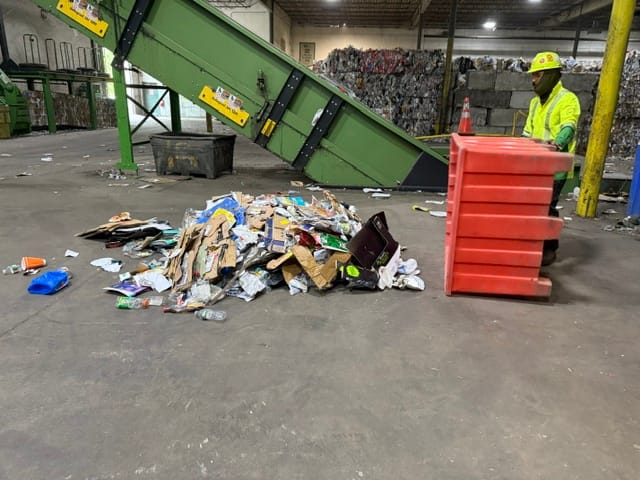
The auditor emptied a 158-pound sample load onto the auditing floor and began his work. At first glance, I was encouraged. There appeared to be very little contamination in the pile. During the 2025 audit, contamination was immediately obvious when the sample was dumped.
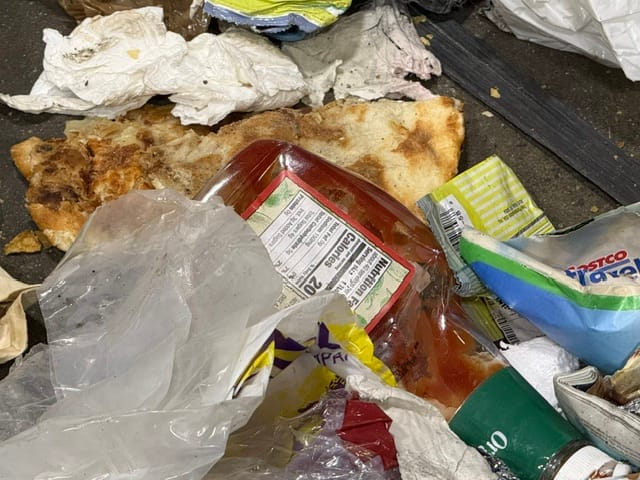
I watched closely as he sorted recyclables from contaminants. Among the items removed were a half-eaten pizza, bottles containing liquid, fabrics, plastic shopping bags, clothes hangers, and rigid wire. Food and liquid taint the recyclable materials rendering them useless. All food and liquid containers should be emptied and rinsed. Food waste should be composted, it is not recyclable otherwise.
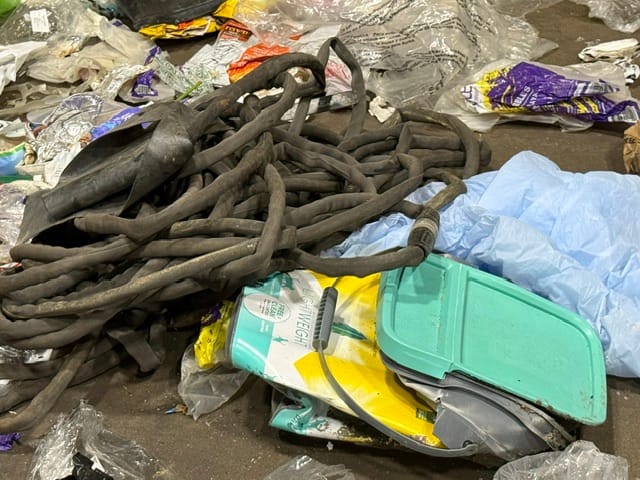
Even then, I remained optimistic. Most of the contaminants I observed were common items and relatively light in weight. However, as the pile was further sorted, I noticed something alarming: a 200-foot hose, complete with connectors and nozzle.
Items such as wires, cords, ropes, and hoses are known as “tanglers.” When they become caught in sorting machinery, they often require manual removal, creating serious safety hazards for workers. The hose lying on the floor before me could easily have damaged equipment or caused serious injury to an employee. As I shook my head in disappointment, the auditor acknowledged my concern.
When the sorting was complete, the contamination rate for the sample measured 31%—well above last year’s final contamination rate of 23% and far higher than our goal of 10%. High contamination rates, such as those over 10% can increase the cost to residents, cases in which the overall contamination is over 30% the recycling facility may refuse the town's collection.
I felt discouraged. The hose and nozzle alone accounted for nearly half the weight of the contaminants in the sample. The phrase “one bad apple can spoil the bunch” came to mind. Yet there was also an important lesson in that realization, which gave me hope. Overall, most residents are responsible with their recycling.
Had that hefty hose and food been disposed of properly rather than placed in the recycling bin, the contamination rate for this sample would have been closer to 11–13% which is much nearer to the target set by the Recycling and Sustainability Committee and Town Management. Contamination not only increases the town's recycling costs, it risks the safety of the many dedicated employees of Waste Management.
The audit will continue through July 3rd. Please help by recycling only accepted materials. When in doubt, leave it out.