

A Land Court judge has declined to dismiss the lawsuit over a proposed battery energy storage system (BESS) at 48 Schoosett Street in Pembroke, and has instead ordered the parties to argue the case through written motions. In a notice of docket entry issued August 4, 2026, Judge Lauren Reznick wrote that she was unconvinced the court could or should act on its own motion to dismiss the claims against Susan Bollinger, the self-represented Pembroke resident whose appeal led the Zoning Board of Appeals (ZBA) to remand the project's site plan approval last spring. Palmer Management Corporation, the developer behind the project, had asked the court to take that step. Reznick pointed to a limit on what dismissal would accomplish. Palmer's lawsuit asks the court to annul the ZBA's decision and confirm that the Planning Board's approval remains in effect. Because Palmer's are the only claims before the court, the judge wrote, dismissing the case would end Palmer's appeal without touching the ZBA decision - leaving the project stalled rather than cleared.
The order followed a joint status report filed July 31, 2026, in which the three parties set out separate positions on how the case should proceed. Palmer argued that the court lacks subject matter jurisdiction and should dismiss the case outright, citing statements it says Bollinger made to the judge during a case management conference held July 23, 2026. Bollinger, in her own section of the same report, said she does not agree that anything she said at that conference amounted to a legal concession on the questions of standing or subject matter jurisdiction, and reserved all of her arguments in response to any motion raising those issues. She deferred to the court on whether the case should move forward through motions, a remand, or some other course.
Palmer and the ZBA told the court jointly that they oppose an involuntary remand - the option that would have sent the matter back to the board to issue a new decision consistent with its July agreement with Palmer. The report does not explain the board's reasoning for opposing a remand. Both asked the court to instead resolve the case through a motion decided on filings already before the court, without new evidence. They proposed limiting that motion to three threshold questions: whether Bollinger had standing to appeal to the ZBA, whether the board had jurisdiction to hear her appeal, and whether there is still a live dispute for the court to decide.
In her order, Reznick described the case as procedurally routine apart from the ZBA's recent agreement that judgment may enter against it. She noted that in comparable zoning appeals, a board often takes a back seat while the private parties litigate the question of standing. Bollinger has not agreed to judgment and has filed no counterclaims, the judge wrote, and is content to let the ZBA's April decision stand. Under the schedule the court approved, Palmer's motion is due within 21 days of the July 31 status report, Bollinger's opposition is due 30 days after that, and Palmer may reply within 10 days, with a hearing to follow.
The case stems from the Planning Board's September 2025 approval of the project's site plan, which the ZBA voted to remand in April 2026 following an appeal by Bollinger citing safety and zoning concerns. Palmer sued the ZBA and Bollinger in Land Court in May 2026, appealing the board's decision and arguing that she lacked standing to bring her appeal. In a stipulation filed July 16, 2026, the ZBA agreed that Bollinger lacked standing and that judgment could enter annulling its own April decision. She was not a party to that agreement.
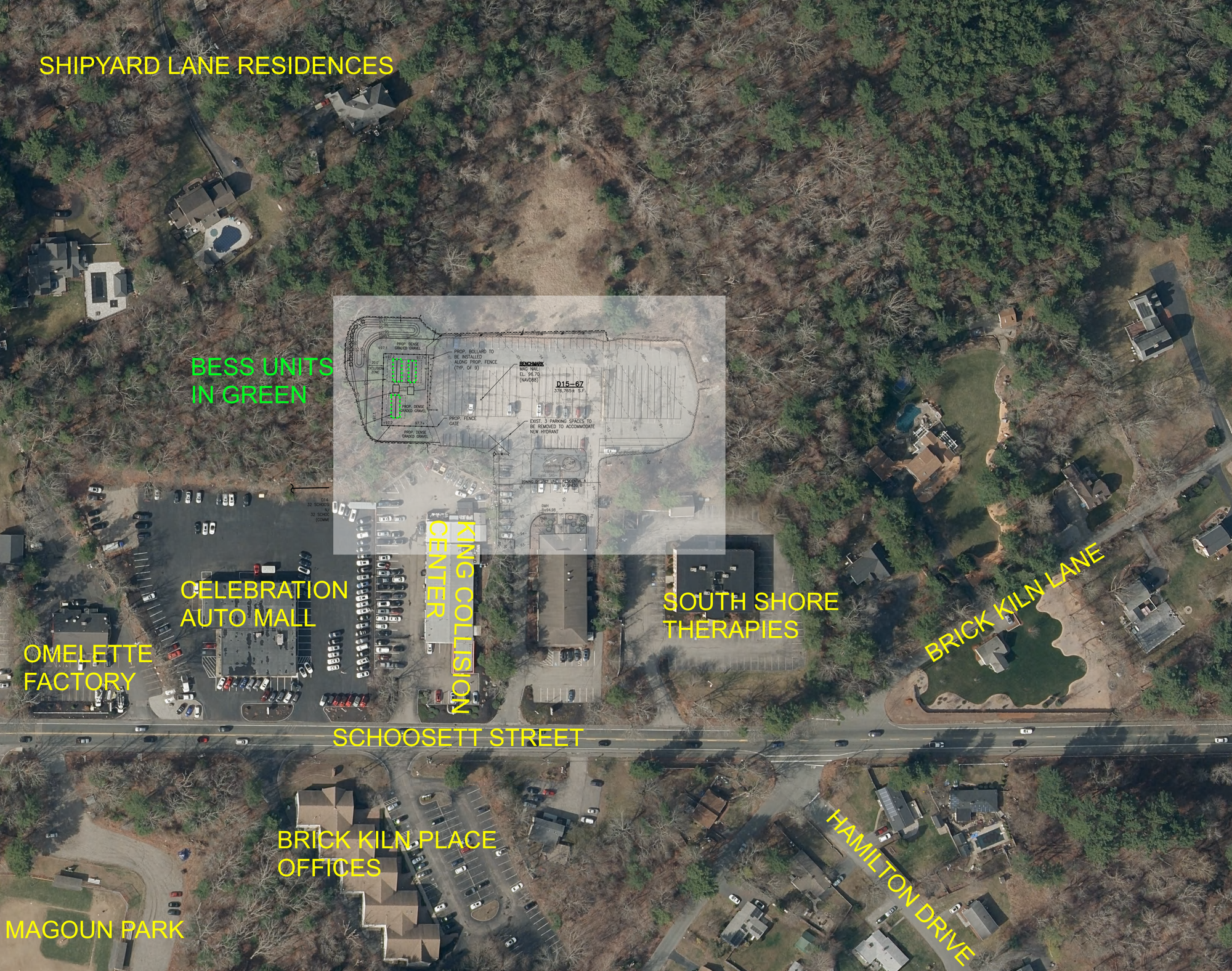
The project would place battery units at the rear of the 48 Schoosett Street property, behind the existing commercial buildings and closest to the homes on Shipyard Lane. Below is the site plan, courtesy of the Planning Board, overlaid on aerial imagery from MassGIS. This is an approximation based on the latest public copy of the plan and may not reflect the final project.
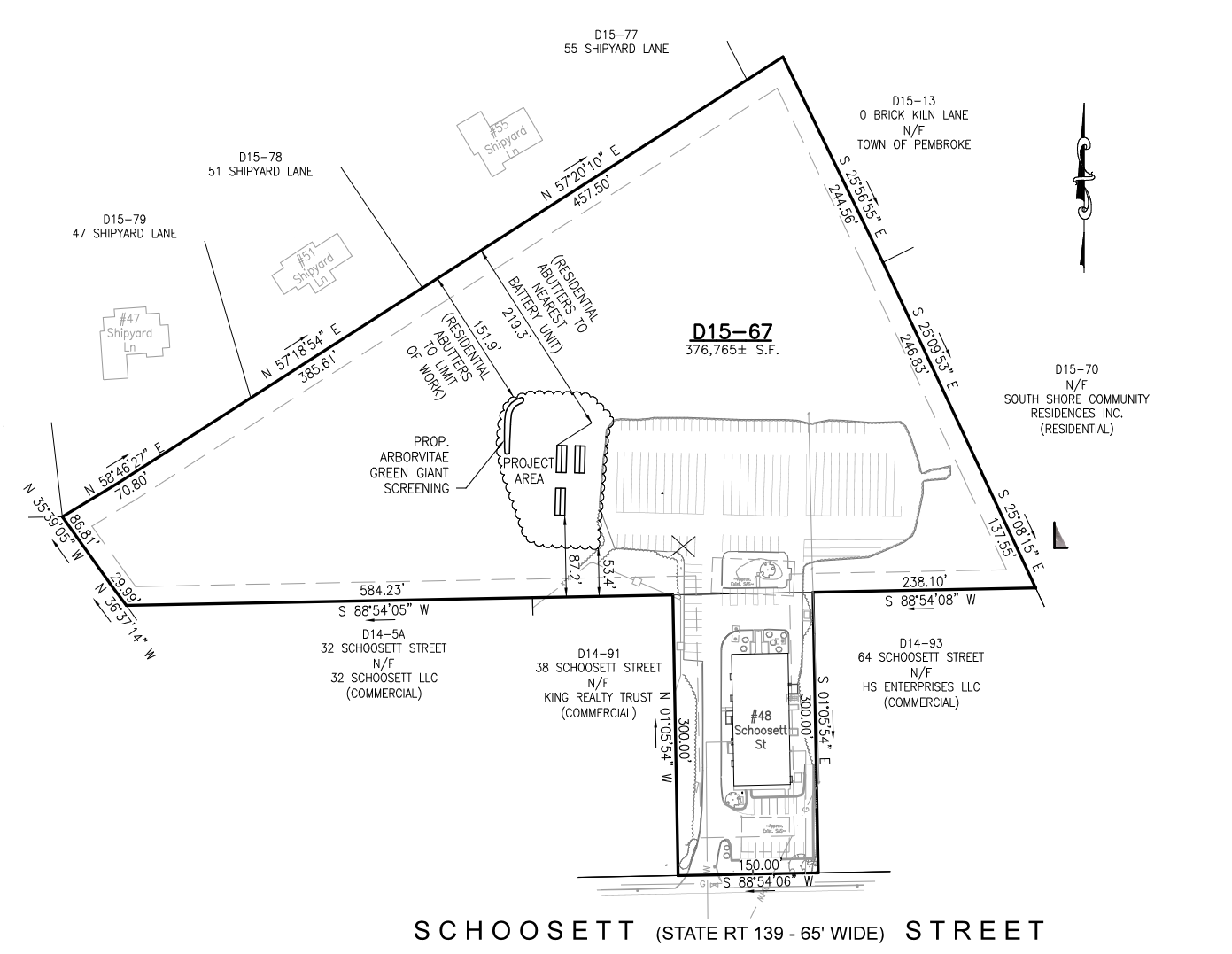
As shown on the site plan, the closest residential abutters on Shipyard Lane are about 220 feet from the nearest battery unit and about 150 feet from the limit of the proposed work.
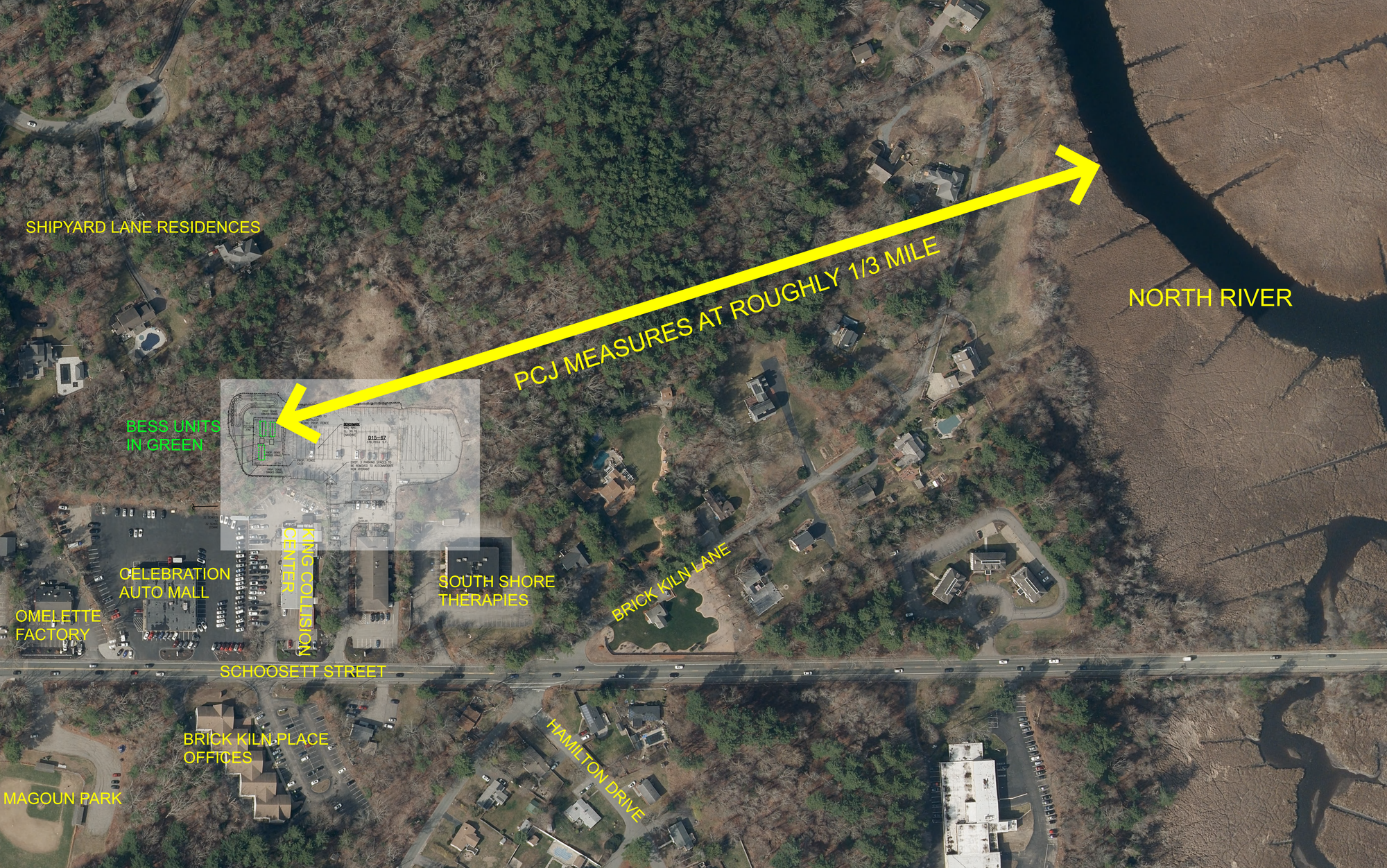
PCJ measurements via GIS mapping tools estimate that the North River is roughly 1/3 mile (~1,700 feet) away from the site.
PCJ covered the history of the project and the stipulation in last week's report.


